
Torrance County Court Record Requests
Start by naming the right office. District Court files belong to the Torrance County District Court Clerk, which sits in the Seventh Judicial District. Magistrate cases go to Torrance Magistrate Court. A Moriarty, Estancia, or Mountainair municipal matter goes to that city court. Informal probate runs through the Estancia Probate Court. The Torrance County Clerk keeps county government records. That office does not hold the District or Magistrate court docket.
A public register gives you the case number. It also shows the court location and a sense of what document or event you need. From there, pick your route. The court-file process allows online searching, eligible registered access, clerk inspection, a phone call, a Judiciary records request, or mail. Whatever you choose, send it to the court that keeps the case.
- Use New Mexico Case Lookup for a public case summary and register of actions. It can identify the court, case number, and event to request.
- For an eligible registered user, check re:Search®NM for digitized information or documents available to that user's approved role and tier.
- Call the filing court before sending payment or mail. State the case number, record requested, case type, and whether a plain or certified copy, audio, or inspection is needed.
- Inspect an available nonrestricted file at the clerk office, or submit the New Mexico Judiciary IPRA request to the Seventh Judicial District for a Torrance court file.
- Mail a District Court request to P.O. Box 78, Estancia, NM 87016 when the clerk directs that route. Use a County IPRA request only for records maintained by the County.
Torrance Court Record Custodians
The court where the case was filed keeps the record. That comes straight from the Judiciary IPRA page. It also notes that the Administrative Office of the Courts does not hold individual case files. This matters in Torrance County. Do not send a District or Magistrate request to the County Clerk. A request routed there just because the case arose in the county will go nowhere.
Torrance County District Court Clerk
Neil Mertz Judicial Complex
903 N. Fifth Street
Estancia, NM 87016
505-384-2974 ext. 40
The Magistrate Court can be reached at 505-832-4476, and it sits at 1100 U.S. Route 66 in Moriarty. For a municipal file, contact the city clerk. With custodians this varied, hang onto the court location shown in the case history.
Kinds of Court Records
A Torrance court docket and the papers behind it are not the same record. New Mexico's public Case Lookup offers a case summary and register of actions. It does not show images of filed documents. For a public pleading, signed order, certified copy, or hearing audio, the responsible clerk is your channel. A transcript is different again. It comes from court reporting, not from the clerk's ordinary copy service.
- Register of actions: the chronological docket list of filings, hearings, and orders.
- Filed document: a pleading, exhibit, signed order, judgment, or other item in the court file.
- Certified copy: a clerk-authenticated copy for an official purpose.
- Hearing audio: a court recording where available, requested separately from the clerk.
- Transcript: a written court-reporting product that requires a separate inquiry to the responsible court.
Torrance Record Layers Compared
One case, several access layers. The public register helps you name the item. The filed document is the item itself, a certification authenticates a copy, and hearing audio preserves a recording where one exists. Treat every layer as a downloadable docket and you may file the wrong request.
| Record layer | What it is | Normal Torrance route |
|---|---|---|
| Register of actions | Chronological filing, hearing, and order history. | Free public Case Lookup, subject to restrictions. |
| Filed document | The actual pleading, exhibit, signed order, or judgment. | Responsible clerk, courthouse inspection, Judiciary IPRA, or eligible re:Search®NM. |
| Certified copy | Clerk-authenticated court copy. | Responsible court clerk. |
| Hearing audio | Recording where the court makes one available. | Responsible court clerk. |
| Transcript | Written court-reporting product. | Ask the responsible court about its reporter channel. No current Torrance rate was located. |
Court Records: What They Contain
What's inside depends on the case. The access rule matters too. The register of actions records the history of filings, hearings, and orders. A file may hold the pleadings and signed court actions behind those entries. Keep in mind that not everything is public. A document missing from Case Lookup does not prove no document exists.
| Case number | The court-assigned identifier. A common published example is D-202-CR-2023-0000, but formats vary. |
|---|---|
| Case summary | Public Case Lookup can show court, parties, attorneys, presiding judge, scheduled hearings, and case-history information. |
| Pleadings and motions | Filed documents that ask for relief, respond to a claim, or request court action. They are not public Case Lookup images. |
| Orders and judgments | Signed court rulings delivered to the clerk for filing and potentially available through the responsible court. |
| Hearing information | Scheduled hearings can appear in the register. The court calendar and clerk are the confirmation route for a live date. |
Torrance Judiciary IPRA Requests
The Judiciary IPRA form moves a clerk request into formal channels when plain email will not do. Pick the Seventh Judicial District on it. You also name the court or department you believe holds the file. Expect to give your own contact details, the person whose records you want, and the record type. Add a case number if one applies. A birthdate field is optional. So is a reasonably particular description of what you are after, though the form asks for one.
The instructions cite NMSA 1978, Section 14-2-8(D). That statute calls for a name, address, telephone number, and a reasonably particular identification of the records. You never have to explain why you are asking. Still, an IPRA request cannot unlock sealed or confidential files, and it cannot override a statute or a court order. It simply routes your ask to the court custodian.
Torrance County runs a separate IPRA form of its own. That route covers County-held material. It takes online, email, or mail submissions. Its listed $1-per-page charge belongs to the County side. The District Court sets its own $0.35-per-page fee for court copies, and that fee governs court files. So a court-file request goes to the filing court or the Judiciary form. Never send it to the County Clerk as though that office were a District or Magistrate case-file custodian.
The official Judiciary IPRA page lays out the court-location step in full. That step matters for a Torrance court-file request. It should name the Seventh Judicial District rather than a County office.
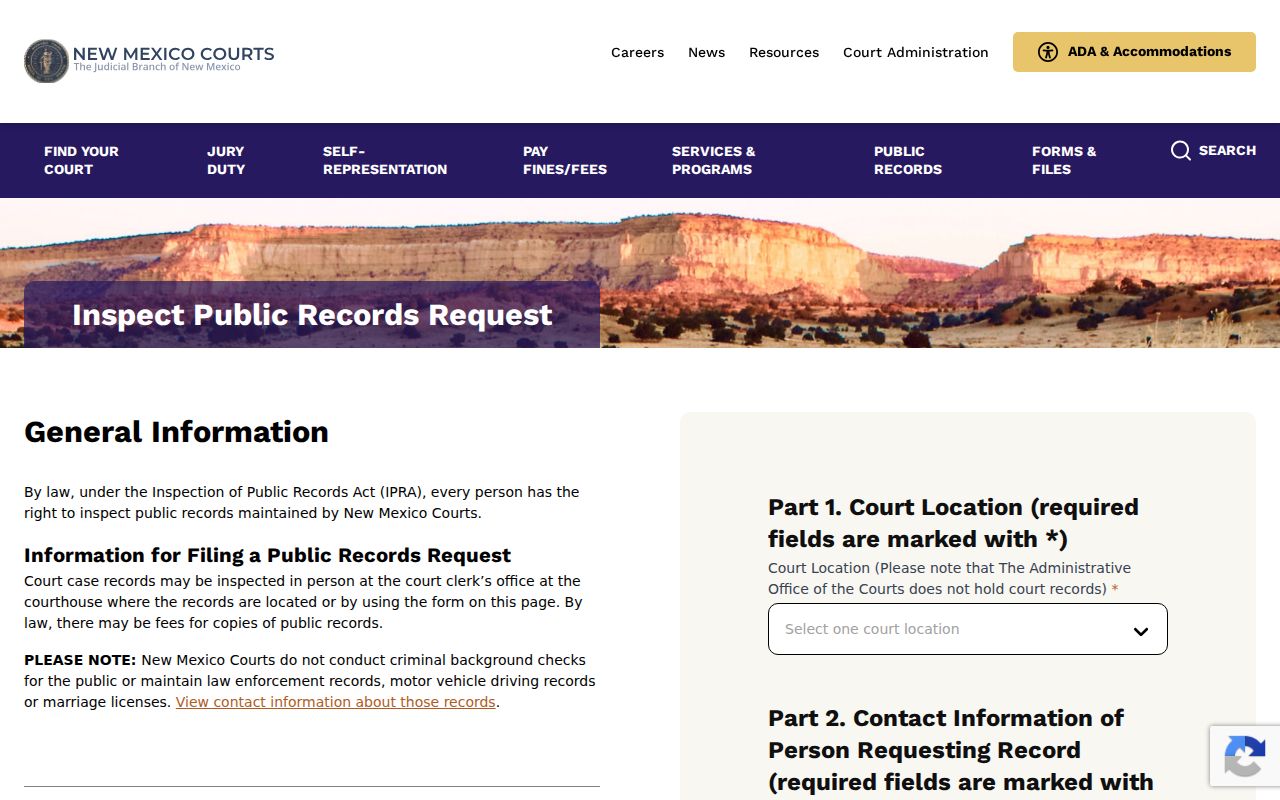
The form is a court-record route. Note that the County's own form, and its $1-per-page charge, do not replace the District Court copy schedule.
Copy Fees and Certification
For documented District Court copy and audio costs, turn to the Seventh District's posted fee schedule. A plain copy and a certified copy are not interchangeable. Certification is billed per pleading. It sits on top of any copy charge. Before mailing payment, ask the clerk about postage, handling, a large file, or availability.
| Item | Posted Seventh District amount | Request note |
|---|---|---|
| Photocopy, including filing packets | $0.35 per page | District Court schedule. |
| Certification | $1.50 per pleading | Added for a certified copy where applicable. |
| Hearing audio | $4.00 per CD | Request separately from the responsible clerk where available. |
| Notarization | $1.50 per signature | Listed by Seventh District. |
| Transcript, exemplification, or special search fee | Not located | Do not assume a rate. Ask the responsible clerk. |
The official fee page comes next. It backs up the plain-copy, certification, and hearing-audio distinctions a Torrance request depends on.
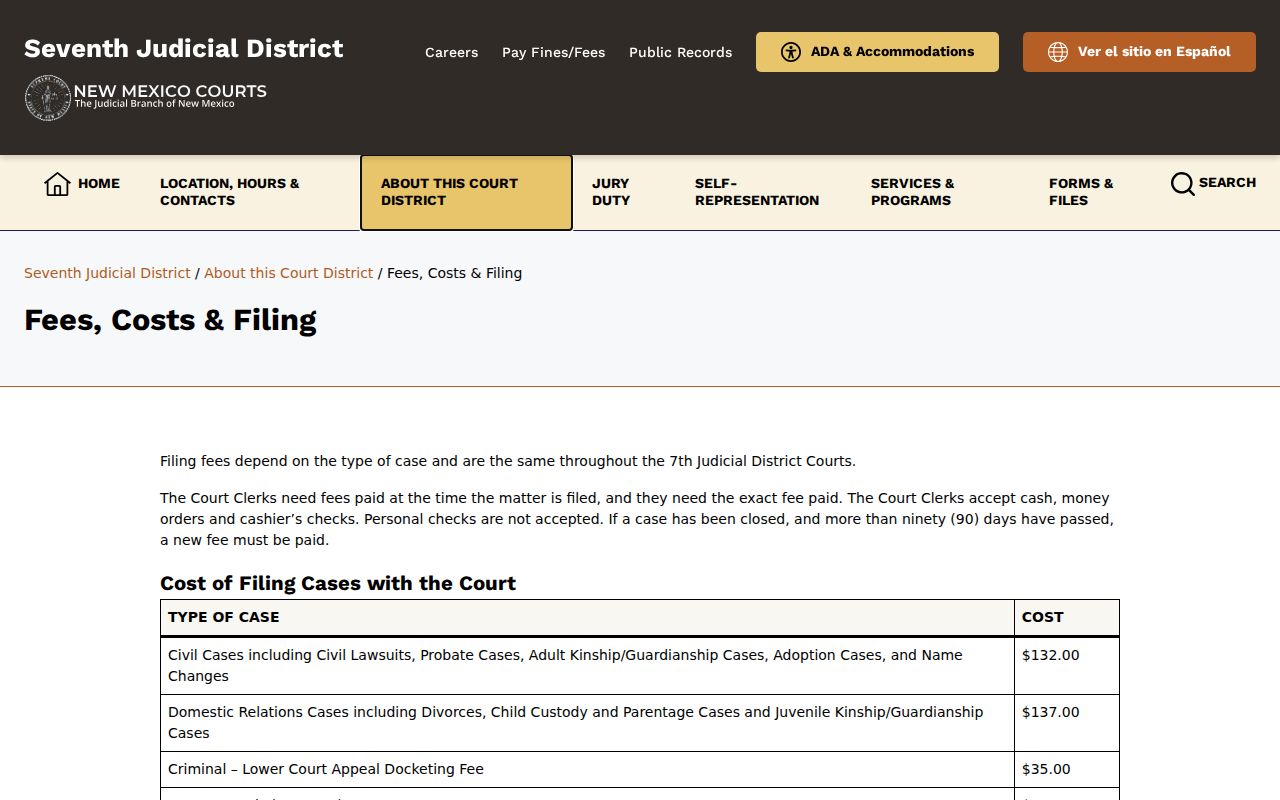
The schedule sets no transcript price and no blanket court-file search fee for Torrance cases.
Torrance Older Court File Requests
For a pre-1997 court file, the Judiciary records-request route is often the practical one. Give the clerk the most complete case number you have. Add the court location, an approximate year, and the case type. Describe the document or event you need in plain terms. Those specifics let the Seventh Judicial District or whichever court made the filing dig up the right record faster.
Age does not move a Torrance County file to some other office. District files stay with the District Court Clerk. Magistrate files stay with Magistrate Court. A municipal record stays with the city court that made it. Call ahead before mailing any large historical copy request. No special archived-file search fee or current transcript rate is published.
Torrance File Inspection Limits
Inspecting a public court file is not the same as borrowing one. Under Seventh District LR7-009, only attorneys and abstracters may check a file out. Even they get no more than three days, subject to the rule's safeguards. Everyone else reads it at the clerk office. That is the line the local rule draws between inspection and removal.
A public, available file starts with the clerk. Contact the clerk first about inspection and how records are handled. Sometimes the register of a case is public but the documents themselves are not available. Then go through the clerk or the Judiciary IPRA route. The court can then apply the access rule to that specific case and record.
Access Rules for Court Records
New Mexico's Inspection of Public Records Act, NMSA 1978, Section 14-2-1 et seq., covers public records kept by New Mexico Courts, subject to exemptions and the responsible custodian. On top of that statute, New Mexico Supreme Court Order 23-8500-007 and the Case Access Policy send the general public to Case Lookup for redacted records. Meanwhile, re:Search®NM uses role-qualified access tiers.
Case Lookup does not hand out filed documents. Several categories sit behind access restrictions: juvenile criminal cases, Family Violence Protection Act order-of-protection cases, personal identifiers, and sealed or confidential records. Even municipal coverage is narrow. The public sees only historic DWI and criminal domestic-violence convictions dating from September 1, 1991, not complete city case files.
Key Rules: NMSA 1978, Section 14-2-8(D) requires contact information and a reasonably particular description for a written records request, but not a stated reason. New Mexico's Case Access Policy limits general-public online access to redacted public records. LR7-009 limits court-file checkout to attorneys and abstracters, not ordinary public visitors.
Note: A court record can be public for inspection while a particular document, identifier, or case category stays unavailable through online or clerk access.