
Torrance County Civil Docket Searches
Start with New Mexico Case Lookup, a free public register that needs no account. It returns civil case summaries and registers of actions. Torrance District Court and Magistrate Court are both covered. Have a case number handy if you can. A party-name search works too: enter last name then first name, with no comma. Add a date of birth when the site offers it, since common names crowd the results. One caution: this is a state register service, not a Torrance County portal. It does not show filed documents.
Know which court you are searching first. General civil, tort, contract, property, domestic-relations, and contested-probate cases sit in the Torrance County District Court docket. Limited civil claims follow a separate clerk. They route through Magistrate Court. Informal probate begins with the Probate Court. Once a search turns up a match, the court name and case number tell you who holds the file. They also tell you who can confirm a hearing date, and who can provide copies.
- Identify the court type from the case number, court papers, or the nature of the civil matter.
- Use Case Lookup with the full case number or the party’s name in the documented name order.
- Open the matching case summary and read the register of actions from the newest event backward.
- Check the latest hearing entry against the court schedule when attendance depends on a current date.
- Ask the filing court clerk for documents, a certified copy, or clarification about an older or unclear entry.
Pick the right court before you search. Torrance County civil filings live at the district court, and its clerk keeps the case file for each one.
Torrance Civil Dockets Above $10,000
Money drives the split between Torrance County's two civil docket paths. Claims above $10,000 belong in District Court. That court handles broad civil litigation: tort, contract, real-property, domestic-relations, and contested estate matters. Smaller claims go to Torrance Magistrate Court, which hears civil cases only up to that $10,000 ceiling. Treat the limit as a jurisdiction rule, though. It is not a filing guarantee for every case that falls under it. The case papers and the court named on them remain the best evidence. They show where a matter actually sits.
| Record route | Common civil matters | Public lookup and file custodian |
|---|---|---|
| District Court | General civil, tort, contract, property, domestic relations, and contested probate | Case Lookup; Torrance County District Court Clerk; Seventh Judicial District record request |
| Magistrate Court | Limited tort, contract, and related civil claims up to $10,000 | Case Lookup; Torrance County Magistrate Court Clerk; Seventh Judicial District record request |
| Probate Court | Informal probate and appointment of personal representatives or special administrators | Call or visit the Probate Court first; contested probate belongs in District Court |
The municipal courts in Moriarty, Estancia, and Mountainair do not handle ordinary civil lawsuits. Their jurisdiction covers city ordinances, code issues, animal control, traffic, and similar local matters.
Civil Dockets: What They Show
A civil register of actions is the event history the court clerk keeps in the computer. Case Lookup exposes several fields. You can see the case number and court, the parties and attorneys, the presiding judge, scheduled hearings, and the chronological register. These entries prove activity occurred. They do not prove the merits of a claim, and they never substitute for a signed court document. Pair the court with the event date whenever a case has moved from a hearing to an order and then to a later setting.
| Case number and court | Identifies the matter and distinguishes the District Court from Magistrate Court route. |
|---|---|
| Parties and attorneys | Names the sides and listed representatives, not the complete facts of the dispute. |
| Register of actions | Chronological list of filings, hearing activity, and court orders. |
| Presiding judge and hearing | Shows the judge identified in case information and a scheduled setting that needs confirmation. |
| Filed documents | Pleading images, attachments, service detail, judgment amount, and lien fields are not confirmed in public Case Lookup. |
The public field limit is deliberate. A register can name a complaint, motion, notice, or order without opening its PDF or exposing every detail in the file.
Note: A Torrance County civil register is an event index; the filing court keeps the signed papers behind it.
Torrance Civil Register and Motion PDFs
A common mistake is treating a docket entry as a link to the document it names. It is not. Case Lookup gives the general public no filed documents. An entry may show that a motion, order, or other event was recorded, yet that does not mean a public PDF, attachment, service record, lien field, or judgment amount exists online. The register is the index. The court file is the document source.
For a pleading, signed order, judgment, or older file, contact the court where the civil case was filed. A nonrestricted file can be inspected at that clerk's office. You can also route a Judiciary request to the Seventh Judicial District through the New Mexico Judiciary IPRA form, naming the responsible court and describing the record with reasonable particularity. Qualified users may have defined re:Search®NM access tiers, but that registered system is not an open public document library.
Practical distinction: use Case Lookup to find the civil event and court, then request the actual record from the court clerk that maintains it.
What Cases Fill the Civil Docket
District Court civil registers can hold general civil actions, tort and contract claims, property disputes, domestic-relations cases, and contested probate matters. Magistrate Court holds limited civil matters within its $10,000 jurisdiction. So a civil docket search needs the court name along with the case style or number. Informal probate takes a separate Probate Court path. A contested estate dispute belongs in District Court.
- General civil actions, contracts, torts, and real-property matters in District Court
- Domestic-relations matters in District Court, subject to public-access restrictions
- Limited civil claims in Magistrate Court up to the documented jurisdictional threshold
- Informal probate appointments in Probate Court
- Contested probate matters that move to District Court
The Seventh District publishes no official civil-docket code list. A category such as CV is a useful civil example inside a New Mexico case number, but it is not a guaranteed Torrance code. Copy every dash and leading zero from the court papers rather than guessing a number format.
Torrance Civil E-Filing and Dockets
The Seventh Judicial District routes civil and probate filings through Odyssey File & Serve. Local rule LR7-019 made electronic filing apply to all civil and probate actions, and it has been mandatory for represented attorneys since an order took effect on August 20, 2012. So a filing travels electronically into the clerk's case file. The platform itself is not a public docket, though. It does not replace Case Lookup, which remains the free public register route. The Seventh Judicial District's Odyssey File & Serve information page names the civil filing service and spells out its court-specific instructions.
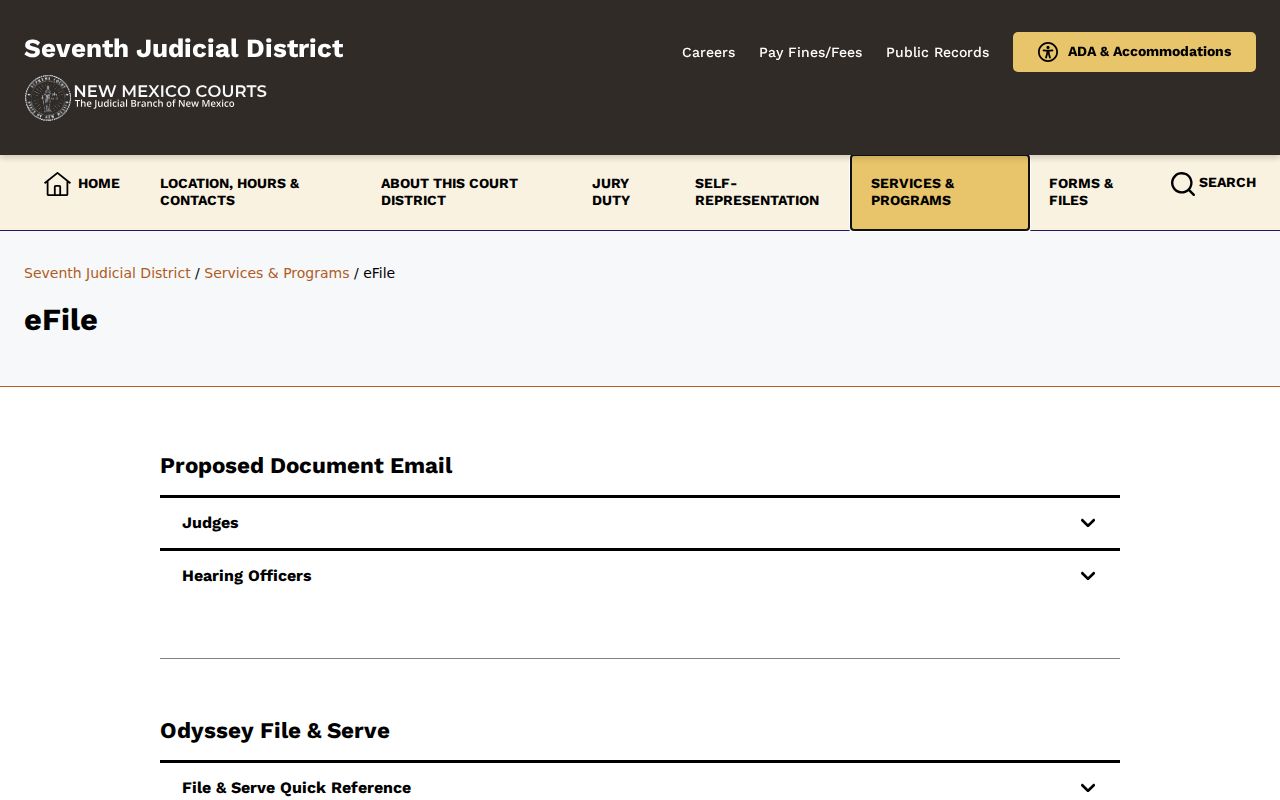
E-filing puts the paperwork into the court system. What the public sees afterward is the docket entry history, not the filed document image.
Hearings on the Civil Docket
Read any civil setting alongside the whole docket, never on its own. A filing opens the case. Service and response activity then shows up in the file history. The exact public labels vary by case. A motion is a request. Under Seventh Judicial District LR7-003, a request for a setting goes to the judge. LR7-013 routes original pleadings to the clerk. That split in labor explains the roles. The judge handles setting requests; the clerk keeps the filed record.
The Torrance County District Court hearing docket covers the current day and six days beyond it. The court cautions that hearing details may be incomplete and offers no warranty. Check that short window against Case Lookup. If the date truly matters, call the filing court. A continuance, later notice, new hearing entry, or order can always replace an earlier setting.
Note: A published schedule is a short-window confirmation tool. Confirm any current civil setting with the court clerk.
Torrance Civil Orders on the Docket
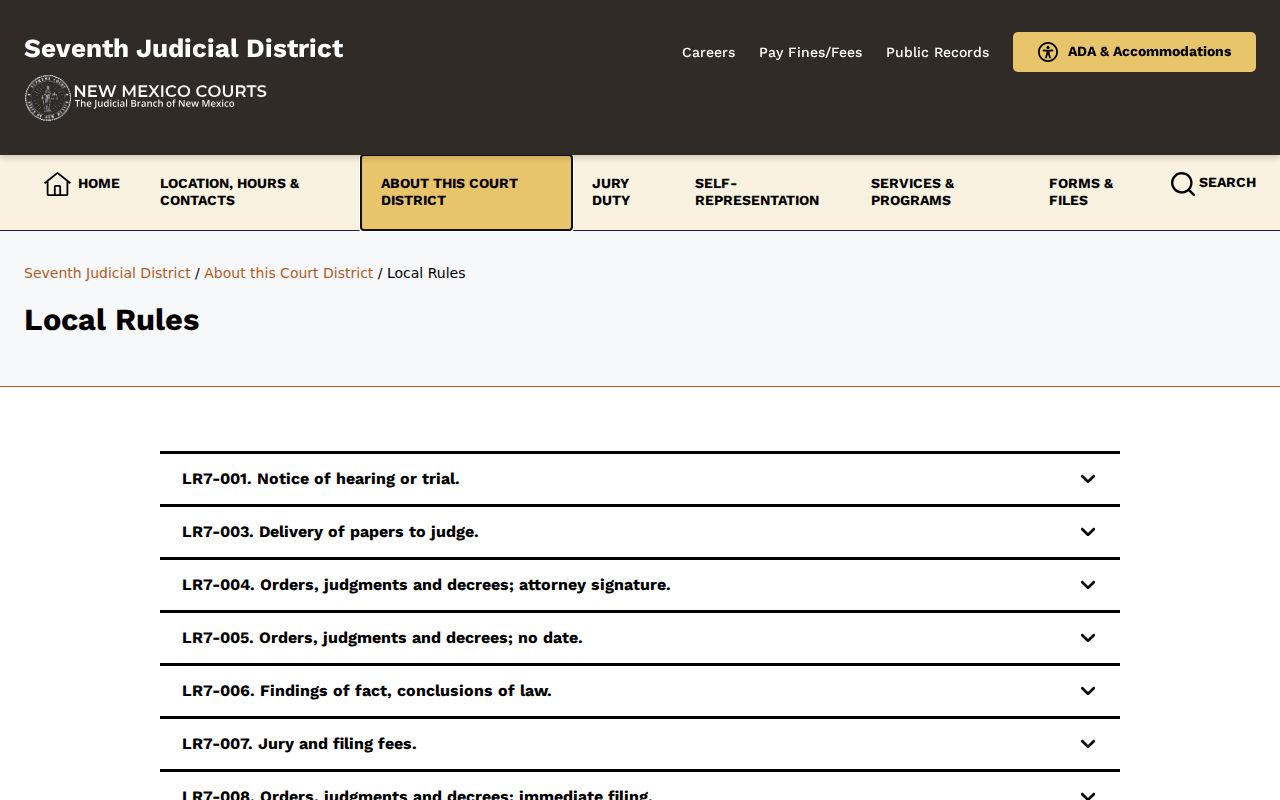
A civil docket usually tells a story in order: filing, response, motion, setting, order or judgment, and sometimes post-judgment work. LR7-008 says that once a judge signs an order, judgment, or decree, it must go promptly to the clerk for filing. The event then shows in the register of actions. Keep one distinction in mind. The register records what happened. The signed order itself stays in the court file, and you get it from the clerk when you need the actual document.
The Seventh Judicial District's locally published rules set out the setting, filing, and order-handling requirements that give a Torrance civil docket its shape.
An appeal out of Magistrate Court can open a District Court docket of its own. So a later District Court case number may signal the appeal stage, not a duplicate civil filing.
Who Can See Civil Dockets
Anyone in the public can use Case Lookup. It shows redacted civil case information and the register of actions. The filed documents themselves are not part of that product. Sealed and confidential records stay closed. That closure runs under the Case Access Policy, statute, rule, or court order. For the right record, go to the filing court clerk. That office, not the Torrance County Clerk, holds the files for cases filed there. The County Clerk has its own duties. It is not the custodian of Seventh Judicial District or Magistrate Court files.
Access rules:
New Mexico Case Access Policy places public online access at the redacted-record level and restricts sealed or confidential material.
New Mexico Judiciary IPRA instructions require a written request to identify the requester and records with reasonable particularity.
LR7-009 permits file checkout by attorneys and abstracters under safeguards; it is not permission for a visitor to remove a court file.
Need District Court copies? The Seventh Judicial District fee schedule lists $0.35 per page plus $1.50 certification per pleading. Ask the clerk to estimate mailing or historical-file costs before you send payment.
Torrance Probate Civil Docket Routes
Informal probate does not start on the general civil District Court docket. Torrance County Probate Court handles informal probate. It also handles the appointment of personal representatives and special administrators. A contested estate goes to District Court instead. The split matters. If a civil docket search turns up no District Court result for an estate, check whether Probate Court holds the file before assuming the record is missing.
Torrance County District Court Clerk
Neil Mertz Judicial Complex
903 N. Fifth Street
Estancia, NM 87016
505-384-2974 ext. 40
Torrance County Probate Court
205 S. Ninth Street
Estancia, NM 87016
505-544-4696 or 505-544-4365
The Seventh Judicial District contact page gives the District Court record route. For informal-probate file questions, call the Probate Court first; bring contested-probate matters to the District Court Clerk.
Note: Torrance County probate routing turns on whether the estate is informal or contested, not just on the word probate.